

EMFF joins the Strategic Alliance for Biodiversity Markets
On November 13, at COP30 in Belém, we co-organized together with the UN Climate Change Global Innovation Hub the Socio-Environmental Dialogue for Peace panel, a space we deeply appreciate for the invitation and for the opportunity to bring together voices that rarely converge: representatives of faith, civil society, the private sector, and academia. Our purpose was clear: to explore how peacebuilding, adaptation, and a just transition require an ethic of listening, shared responsibility, and cross-sector cooperation.
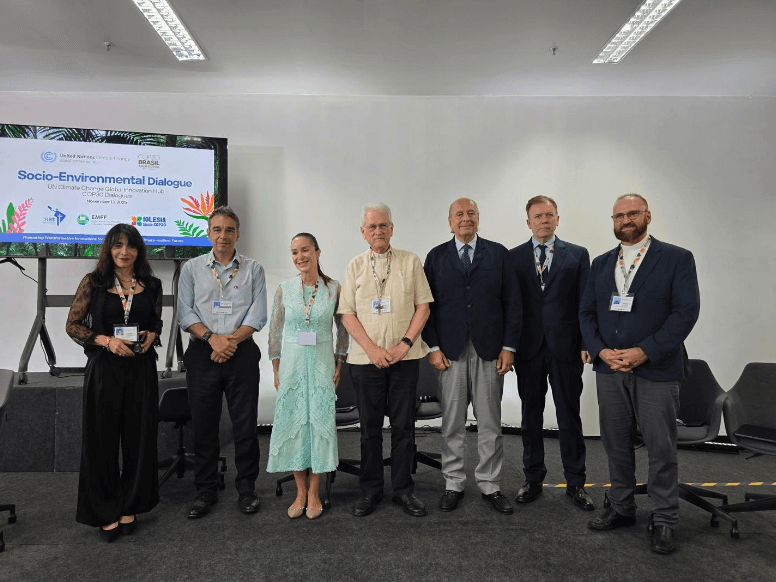
Listening as a Starting Point for Peacebuilding
Cardinal Leonardo Steiner, Archbishop of Manaus, opened the panel by reminding participants that genuine dialogue begins with attentive listening—listening capable of transforming the very logic that governs our relationship with nature. He urged a shift from a paradigm of domination to one of harmonious coexistence and deep respect for the environment.
Building on this ethical foundation, Dr. Eduardo Agosta—Carmelite friar and Catholic priest, Director of the Department of Integral Ecology at the Spanish Episcopal Conference—reflected on the decade since the Paris Agreement. While scientific goals and policy roadmaps are clear, political will remains insufficient. In this context, Laudato Si’ offers crucial guidance: an ethical approach that sees the climate crisis not as a purely environmental issue, but as one deeply connected to justice, community, and human dignity—principles indispensable for a just transition.
Global Mutirão: A Call for Collective Action
Professor Juliano Assunção, Associate Professor in the Department of Economics at PUC-Rio, expanded the discussion by highlighting the COP30 presidency’s call for a global mutirão—a coordinated collective effort to accelerate climate action. He stressed that this call requires mobilization across borders and sectors, recognizing that everyone has a role in shaping a just transition. In this sense, the Amazon stands as a powerful symbol of the fraternal ties between people and nature.
Private Sector Perspectives: Responsibility, Transparency and Dialogue
The panel then welcomed perspectives from the critical minerals and energy sectors.
José Luis Manzano, CEO of Integra Capital, reflected on his recent audience with Pope Francis during the final days of his papacy, where the Holy Father urged him to amplify the private sector’s responsibility in advancing a just transition. Manzano emphasized the need for a comprehensive approach—one in which capital is not seen as an adversary but as a tool capable of driving meaningful solutions—and highlighted the importance of placing inclusive, fraternal dialogue at the center of both public policies and corporate strategies.
The discussion continued with insights from Ana Cabral, CEO of Sigma Lithium, the world’s fifth-largest hard-rock lithium producer. She reflected on the profound social and environmental responsibilities of companies in strategic mineral sectors, which led Sigma to become a carbon-neutral lithium oxide producer. In the countries of the Global South—home to the mineral reserves that make the energy transition possible—she argued that faith becomes a transformative force for building social peace and fostering constructive engagement with local communities.
Ethical and Social Dimensions of the Transition
Taken together, these contributions underscored a shared understanding of the ethical and social dimensions of climate action. A core message throughout the session was the urgency of strengthening active listening across sectors with differing roles in the transition.
As Hon. Emilce Cuda emphasized:
“Dialogue without listening becomes imposition. Caring for our common home requires encountering the other with honesty and humility.”
Patricio Lombardi grounded the discussion in the mandate of Article 12 of the Paris Agreement, noting:
“It is not only about markets; it is about awareness.”
The session brought together actors who rarely sit at the same table, creating space for alliances uncommon in traditional environmental forums. It reaffirmed a central truth: a just transition must integrate the technological with the human—and the economic with the territorial.
Our Commitment
At EMFF, we believe that building peace—among people and with nature—requires trust, transparency, and shared responsibility. From Belém, we renew our commitment to continue promoting spaces where diverse voices can listen, meet, and cooperate to advance a just transition guided by integrity and ethical coherence.
The future of environmental markets and the wellbeing of our common home depend on ensuring that these encounters become sustained practices rather than exceptions. We will continue working with determination to strengthen this vision together with our partners and communities.
We invite you to continue reading our complementary COP30 content.
Follow us on our social networks for more content