

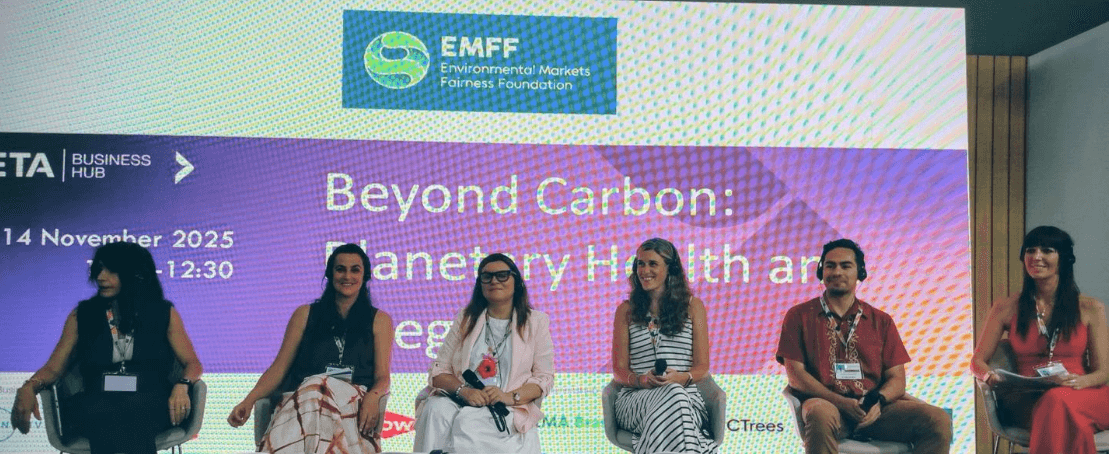
On November 14, during COP30 in Belém, Brazil, we participated in the panel Beyond Carbon: Planetary Health and Integrity, held at the IETA Business Hub — whom we warmly thank for hosting the session. Moderated by Patricio Lombardi, the discussion explored the interdependence between nature, health, and development, underscoring that climate action cannot be reduced to carbon metrics alone.
Ethics, Social Justice, and the Vision of Laudato Si’
Hon. Emilce Cuda, Secretary of the Pontifical Commission for Latin America, opened the session by drawing on her long-standing work alongside Pope Francis and, today, under the guidance of Pope Leo XIV. Speaking from years of experience in multilateral forums, she stressed that ethics and social justice must guide climate action, especially as the world marks ten years of Laudato Si’.
Echoing Pope Leo XIV’s message to “build bridges,” Dr. Cuda urged an open, inclusive, and socially grounded response to the planetary crisis.
Scientific Evidence: A Regional Wake-Up Call
Dr. Stella Hartinger, Director of Lancet Countdown Latin America, presented the key findings of the 2025 LCLA report. Her intervention carried a stark warning: mitigation and climate-action indicators across the region are not improving — in many cases, they are worsening.
This trend, she emphasized, is a serious alarm for governments and institutions to reassess how they are preparing for scientific scenarios that are rapidly approaching if commitments continue to fall short.
Energy Sector Realities: Infrastructure, Adaptation, and Transparency
From the operational perspective of the energy sector, Silvana Coria, Planning and Control Manager at Edenor S.A., highlighted the company’s ongoing commitment to environmental responsibility. Representing Edenor at COP for the second consecutive year, she described progress toward international standards of transparency, continuous improvement, and sector-wide alliances.
She stressed the practical challenges of the transition — particularly in electricity distribution infrastructure — and the lessons learned as companies adapt to rapidly evolving demands.
Community-Centered Action: Education and Participation
Shifting to a community-centered perspective, Carolina Mónaco, Executive Director of Eco House Global, detailed how the organization works closely with communities — especially youth — using education as a transformative tool for participation and empowerment.
She shared examples of interactive campaigns in vulnerable areas, fostering more humane and locally grounded development. Mrs. Mónaco also highlighted their partnership with EcoNews, the Spanish-language socio-environmental media outlet with the widest global reach, reinforcing a commitment to accessible, high-quality information.
Environmental Markets Perspective: Connecting People with Nature
From the standpoint of environmental markets, Humberto Juárez Rocha, Carbon and Biodiversity Editor at OPIS (A Dow Jones Company), offered insights into private-sector behavior and emerging nature markets.
He explained OPIS’s decision to dedicate specific coverage to the biodiversity-credit market, emphasizing that emotional and experiential connection with nature is essential for decision-makers. Once that connection is established, rigorous data and analysis can clearly demonstrate the economic urgency of acting now.
Corporate Sustainability: Strategy, Risk, and Opportunity
Closing the panel, Belén Zermatten, Director of Sustainability & Climate Change at PwC Argentina, provided a practitioner’s view of how companies are integrating sustainability into strategy and decarbonization planning.
She noted that sustainability is increasingly becoming a competitive advantage, strengthening trust with clients and investors as environmental impacts emerge as material risks. She also highlighted the rising incorporation of biodiversity requirements in global standards and the expansion of tools to measure nature-related impacts, risks, and opportunities.
A Shared Mission for a Fair Transition
The discussion made clear that advancing climate and nature action requires ambition, innovation, and — above all — fairness. Ethical leadership, scientific evidence, community engagement, and responsible markets must move together.
This is precisely the mission of EMFF: to help forge transitions grounded in integrity, justice, and cooperation.
Only through this shared commitment can we build the inclusive, high-integrity transition that our region — and the planet — urgently need.
We invite you to continue reading our complementary COP30 content.
Follow us on our social networks for more content